HISTORY
Department Vision
Historians at Stone Lodge School (SLS) will have access to a high-quality knowledge-rich curriculum through which they will gain a coherent understanding of Britain’s past whilst also looking at how Britain interacted with the wider world. Historians at SLS will be inquisitive, self-led learners, who will develop key conceptual skills that enable them to think critically, evaluate evidence, analyse differing historical interpretations, and develop their own judgements about the past. Students will be able to see themselves reflected positively in the History curriculum and understand how their place in Britain and the wider world came to be. They will leave SLS with an understanding of the complexity of life in Britain, how life in Britain developed and how Britain’s relationships with the wider world have changed over time. SLS historians will be global citizens who may go on to be change-makers of the future.
Year 7
In Year 7, students begin their journey into History by building a strong foundation of knowledge about Britain and the wider world up until the Tudor period. Through a knowledge-rich curriculum, pupils explore how past societies lived, how power was held and lost, and how ideas, religion, trade, and culture shaped people’s lives.
Topics include the Anglo-Saxons and Vikings, the Norman Conquest, early medieval rulers, and interactions with broader global empires — for example through trade routes like the Silk Roads. Students are encouraged to think like historians: asking big questions, analysing different sources, recognising change over time, and understanding the significance of events.
By the end of Year 7, students should be able to trace a timeline of key events, use sources, compare different interpretations of history, and begin to see connections between Britain’s past and the modern world. This year aims not just to teach what happened, but to help students understand how history shapes power, identity, and society.
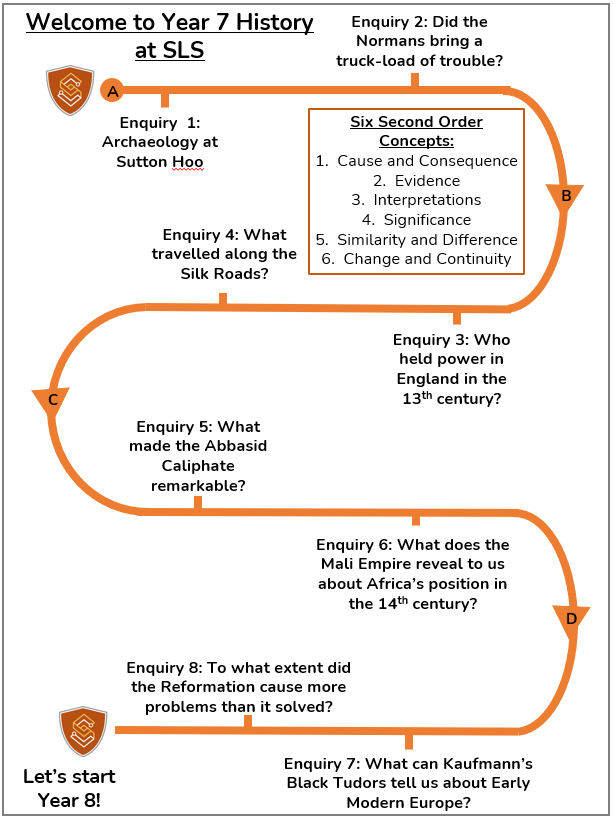
Enquiries that students will explore throughout the academic year;
| What are the dangers of History? What can Sutton Hoo reveal to us about Anglo-Saxons and Vikings? Did the Normans bring a truck-load of trouble to England? | |
| Who held power in Britain before the 13th century? What travelled along the Silk Roads in 1345? | |
| What made the Abbasid Caliphate remarkable? What does the Mali Empire reveal to us about Africa’s position in the 14th century? | |
| What can Kaufmann’s Black Tudors tell us about early modern Europe? To what extent did the Reformation cause more problems than it solved? |
Year 8
In Year 8, students explore the events, ideas, and people that shaped the modern world. They study key moments in history, from the growth and impact of the British Empire to the struggles for freedom and equality, including the Transatlantic Slave Trade and movements for abolition. Students also examine the profound changes brought by the Industrial Revolution and the development of democracy in Britain, before moving on to the complex causes of the First World War.
Throughout the year, students develop essential historical skills. They learn to analyse sources, evaluate different interpretations, and make reasoned judgments about the past. By exploring cause and consequence, significance, and change over time, students gain a deeper understanding of how history has shaped societies and individuals. Year 8 History encourages curiosity, critical thinking, and a global perspective, helping students become thoughtful and informed citizens.
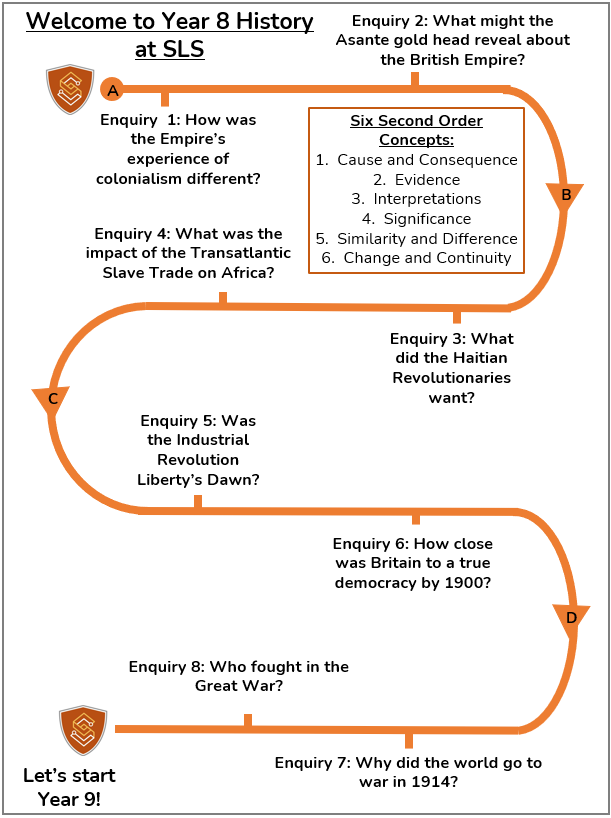
Enquiries that students will explore over the academic year;
| Why did the British Empire begin? How different was life under the British Empire? What might the Asante gold head reveal about the British Empire? | |
| What did the Haitian revolutionaries want? What was the impact of the Transatlantic Slave Trade on Western Africa? Who abolished the slave trade? | |
| Was the IR Liberty’s Dawn? How democratic was Britain by 1900? | |
| Why did the world go to war in 1914? Who fought in the Great War? |
Year 9
In Year 9, students explore the turbulent events and global changes of the 20th century. The year begins by examining how the USA and USSR responded to post-war challenges, helping students understand the differences between democracy and totalitarianism, in preparation for their GCSE learning the following year. Pupils then use historical sources to investigate everyday life in Europe from 1919–1945, exploring the Holocaust and life in Europe under the control of the Nazis.
The curriculum also covers the origins of conflict in Israel-Palestine and the factors behind the decolonisation of the British Empire, encouraging students to consider cause, consequence, and significance. Students explore the British Civil Rights movement, assessing the importance of historians to modern debate – like David Olusoga. Finally, they investigate the consequences of World War II on the Middle East, linking local events to broader global changes.
Throughout the year, students develop key historical skills, including analysing sources, evaluating interpretations, and making comparisons across time and place. By the end of Year 9, students will have a solid foundation for understanding modern history, preparing them for more complex enquiries in Year 10 and beyond.
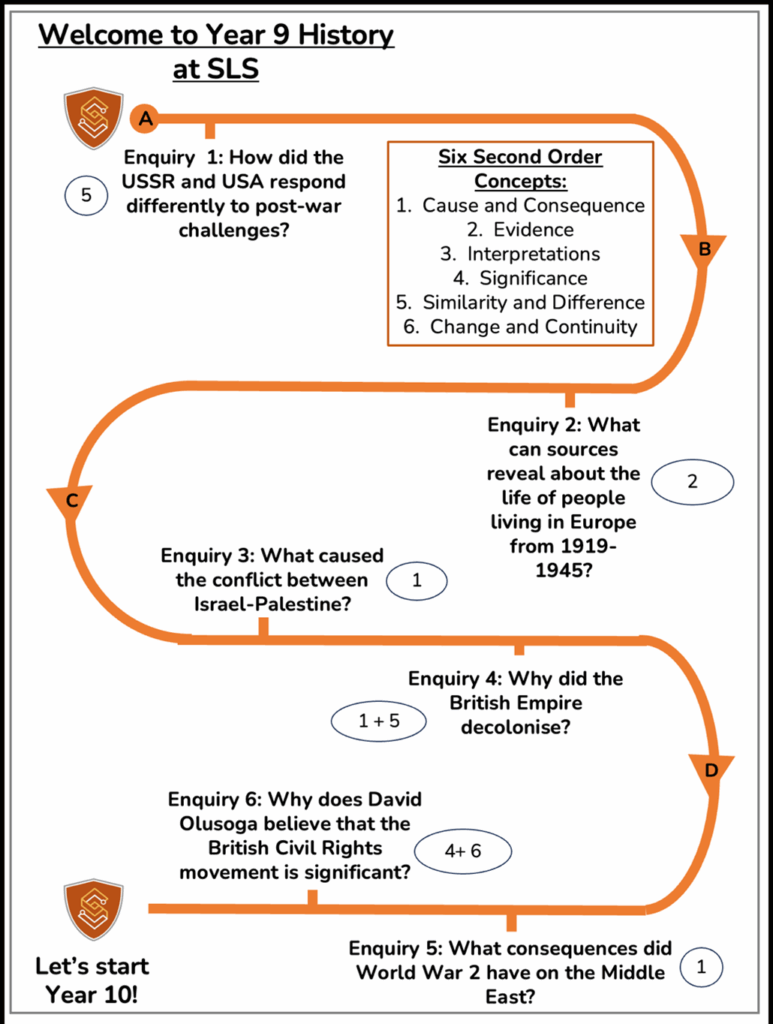
Enquiries students will explore over the academic year;
| How did the Nazis rise to power? How were the Nazis able to implement the Final Solution? | |
| Why was the state of Israel created in 1948? How far has modern conflict shaped the modern world? | |
| How different was decolonisation? Who should be seen as responsible for the chaos of partition? | |
| Who are the Windrush generation? How far has Britain changed beyond all recognition since 1945? |
Years 10 & 11
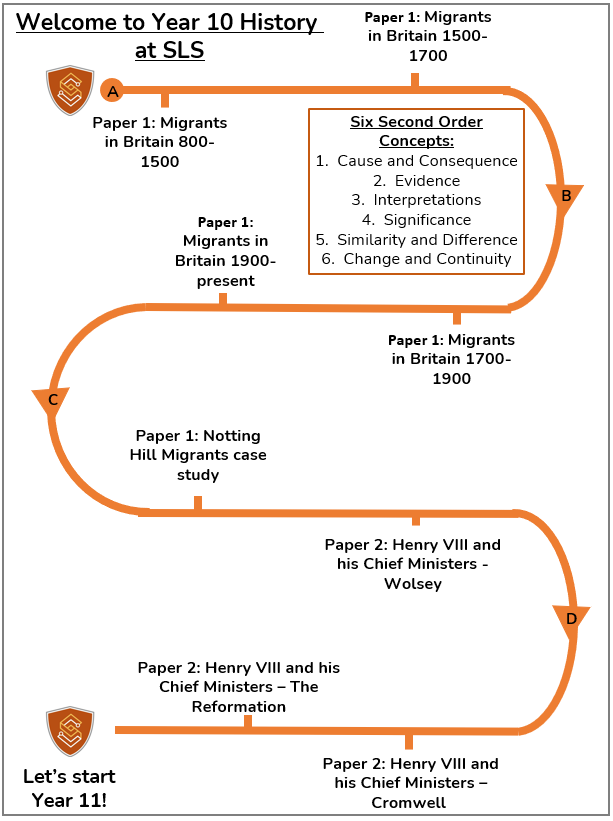
Having gained experience with the second order concepts throughout KS3, the skills of Stone Lodge Historians are shaped further in Key Stage 4. Students will continue to utilise and enhance the core conceptual skills of a historian whilst being challenged to reflect on how history has shaped the world around them.
Key Stage 4 is a two-year journey that sees students prepare for the Edexcel History GCSE. Details of the topics studied can be viewed in the Long-Term Plans section below.
Year 10
| TERM 1 | Paper 1: Migrants in Britain 800-present. |
| TERM 2 | Paper 1: Migrants in Britain 800-present. |
| TERM 3 | Paper 1: Migrants in Britain 800-present. |
| TERM 4 | Paper 2: Henry VIII and hist chief ministers. |
| TERM 5 | Paper 2: Henry VIII and hist chief ministers. |
| TERM 6 | Paper 2: American West 1835-95. |
Year 11
| TERM 1 | Paper 2: American West 1835-95. |
| TERM 2 | Paper 3: Weimar and Nazi Germany 1919-39. |
| TERM 3 | Paper 3: Weimar and Nazi Germany 1919-39. |
| TERM 4 | Paper 3: Weimar and Nazi Germany 1919-39. |
| TERM 5 | Revision. |
| TERM 6 | Revision. |
Advice For Parents & Carers
History is all around us. There are a wealth of historical sites or places of interest in Kent and the surrounding area from the preserved Roman Villa at Lullingstone to the Leeds and Dover Castles. The History department has its own library of fiction and non-fictions books that complement our curriculum which are accessible to all historians. We also have a subscription to the BBC History Magazine, although parents may wish to purchase this magazine for enthusiastic historians to have easy access at home.
At Key Stage 3, we frequently use Pearson’s Exploring History textbooks and whilst there is no expectation to purchase these for home use parents can buy these from online marketplaces.
The departmental Knowledge Organisers that are published each learning cycle are an invaluable tool in preparing students for their end of cycle assessments. The department also recommends that students keep these throughout Key Stage 3 and 4 to best prepare them for their studies.
In addition, the following websites are invaluable to students. We encourage you to support your child to use them for independent studies:
· https://www.historyextra.com/
· https://www.bbc.co.uk/bitesize/subjects/zk26n39